
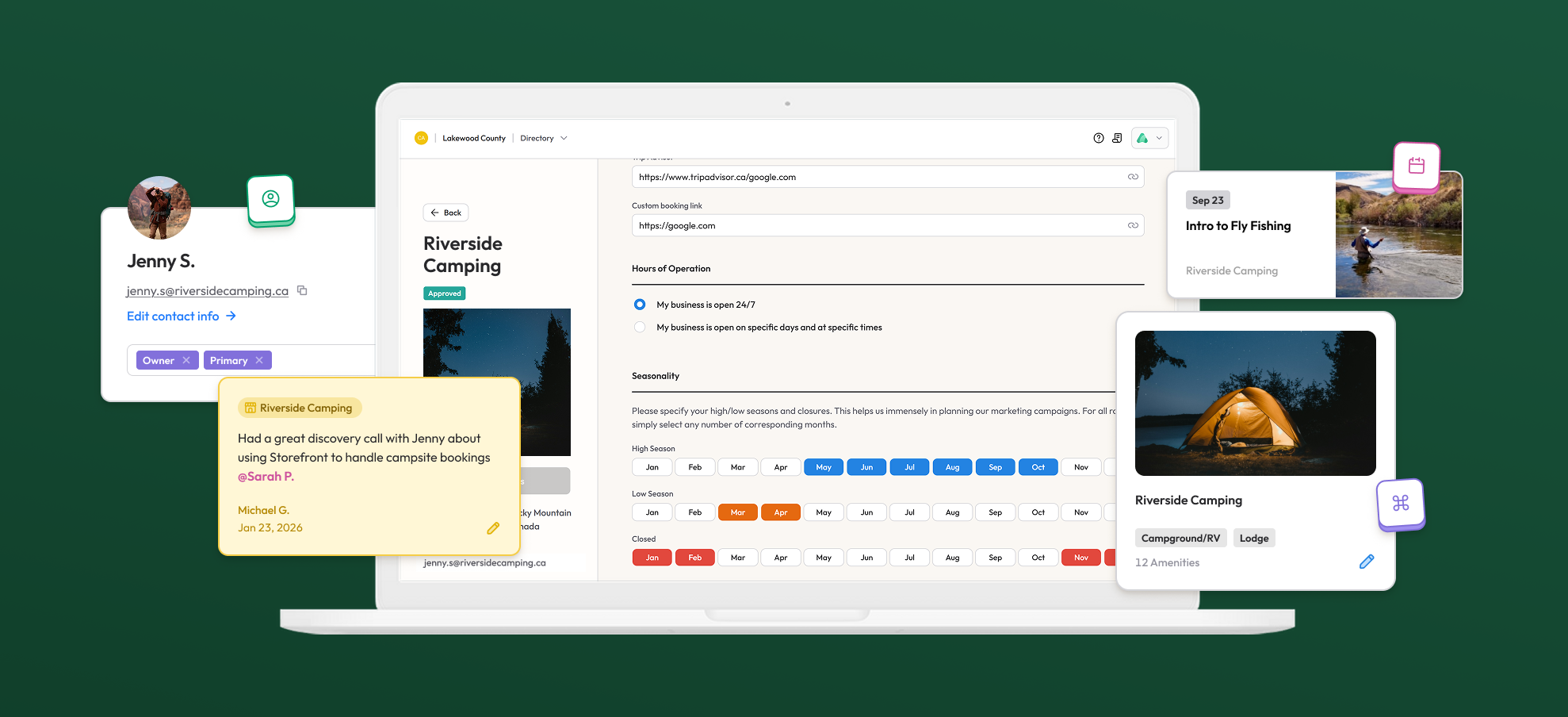
The complete guide to DMO and CVB CRM software

If you're running a small to mid-sized Destination Marketing Organization (DMO), Convention & Visitors Bureau (CVB), or tourism board, you've probably discovered that generic CRMs like Salesforce or HubSpot weren't built for your world. You need software that understands stakeholder management, event calendars, website widgets, and member directories, not sales pipelines and lead scoring.
You've also probably experienced the frustration of enterprise DMO software pricing: the base platform looks reasonable, but then you discover that email marketing is extra, booking tools are extra, the event calendar is extra, and every new feature means another invoice. Before you know it, you're spending double what you budgeted.
This guide compares the major DMO-specific CRM options so you can find the right fit for your team and budget, including which ones charge for every feature and which give you everything upfront.
Who this guide is for
This guide is written specifically for:
- Small to mid-sized DMOs and CVBs without dedicated convention sales teams
- Tourism organizations where stakeholder management matters more than meeting planner pipelines
- Teams stuck between scrappy spreadsheets and enterprise software they can't afford
- Anyone who's been burned by "add-on" pricing that doubled their software budget
If you're a large CVB with a sales team chasing convention business and you need Cvent integration and economic impact reporting, Simpleview or Tempest are probably your best options and this guide will still help you understand them. But if that's not you, read on.
A note from the author
My name is Matthew Thomas, I've worked in the tourism industry for over 15 years, both inside DMOs large and small, as a tourism business owner, and as a consultant helping destinations across the country. I've lived the reality of managing stakeholders in spreadsheets, navigating through features in complicated CRMs that weren't built for tourism, and watching small destinations get priced out of tools that could genuinely help them. I'm a co-founder of Whereabouts, one of the products reviewed in this guide. This guide is my honest attempt to lay out the landscape as I see it. I've done my best to be fair to competitors, highlight where they genuinely excel, and be clear about where Whereabouts falls short. If you need convention sales tools and Cvent integration, we're not your solution and I'd rather you know that upfront than waste your time.
Market overview: who are the players?
The DMO software market is dominated by a few key players, each with different strengths and target markets:

Detailed reviews
1. Simpleview (by Granicus)
Market Position:
The dominant enterprise player, now owned by government software giant Granicus. Used by over 1,000 destinations worldwide including major CVBs like Visit Tampa Bay, Hawaii Visitors Bureau, and Visit Salt Lake.
Core features:
- Comprehensive CRM with 125+ industry-standard reports
- Meeting/convention sales pipeline with MINT+ and ICCA integration
- Partner portal (Marketplace) for co-op campaigns
- Tight integration with Simpleview CMS for websites
- 20+ third-party integrations (Cvent, CrowdRiff, Act-On)
- Economic impact reporting and forecasting tools
✔️Pros (from user reviews):
- "All-encompassing—handles all our data and we don't even use all the features"
- "Seamlessly connects all areas of a DMO to help perform at peak ability"
- "Reporting is very useful and highly customizable"
- Strong customer support reputation
❌Cons (from user reviews):
- "Software feels old and looks outdated, outages more frequent"
- "Search function is complicated—drop down menus so extensive it's hard to pick"
- "Every customization is an added cost to an already expensive program"
- "Confusing when first starting—needs more how-to resources"
- Steep learning curve requires dedicated training
- Modular pricing means costs escalate quickly—DAM, email marketing, booking tools, and other features all require additional fees
Pricing:
Not publicly disclosed. Historical pricing started at $99/user/month for basic CRM, but full implementations with CMS, DAM, and services typically run $30,000-100,000+/year for mid-sized destinations. Beware: each module is priced separately. Email marketing (Act-On integration), booking engine (Book › Direct), DAM, and other features all add to your annual invoice. What starts as a reasonable quote can balloon as you discover essential features require additional licensing.
Best for:
Large DMOs with dedicated IT/CRM staff, convention sales teams, and budgets exceeding $50,000/year for technology. Organizations that need deep meeting planner integrations and economic impact reporting.
2. Tempest / iDSS Cyclone
Market position:
The #2 player, positioning itself as "built by a DMO for DMOs." Used by 170+ destinations including Visit Dallas, Wisconsin Dells CVB, and Discover Lancaster. Recently acquired Jupiter CRM technology from Visit Indy to strengthen sales capabilities.
Core features:
- Full CRM with sales, membership, marketing, and finance modules
- Extranet for partners to manage their own listings
- Built-in email marketing and proposal generation
- Sports Tourism Index for competitive benchmarking
- Cvent integration for RFP management
- Meeting space management module
- Event registration (iDSS Attend)
✔️ Pros:
- "Never worked with a software provider with better tech support"
- Account-based platform with no departmental silos
- Modern .NET technology stack with monthly feature updates
- Strong focus on meetings, events, and sports tourism
- Annual Tourism Academy conference for training
❌Cons:
- Limited public reviews make independent evaluation difficult
- Primarily sales-focused—may be overkill for destinations without convention business
- Requires commitment to their ecosystem (website + CRM)
- Pricing not transparent
- Premium features like Meeting Space management and iDSS Attend event registration are add-on subscription fees
Pricing:
Not publicly disclosed. Contact required for quotes. Expected to be similar to Simpleview for comparable implementations, though positioned as potentially more affordable for mid-market.
Best for:
Mid-sized DMOs with active meeting/convention sales, sports tourism programs, or those wanting an alternative to Simpleview's dominance. Organizations that value responsive support and regular platform updates.
3. Whereabouts
Market position:
Purpose-built destination management software for small to mid-sized DMOs and Visitor Bureaus. Focused on stakeholder management, website widgets, and enabling direct bookings—rather than sales pipelines. Award-winning platform recognized by Travel & Hospitality Tech Outlook as Top Destination Management Software in Canada.
Core features:
- Stakeholder Directory: Centralized database of operators, attractions, restaurants, and partners with detailed profiles, tagging, and interaction tracking
- People Management: Track relationships with humans behind organizations—not just companies
- Website Widgets: Embeddable listings that auto-update when operators change their info (no developer required)
- Events Calendar: Easy submission, approval workflow, instant website publishing
- Member Self-Service: Businesses update their own listings, reducing admin burden
- Analytics Dashboard: Track referrals, clicks, and traffic generated for stakeholders
- Broadcasts: Send targeted updates to stakeholder segments
- Itinerary Builder: Create and share curated experiences
- Storefront (Bookings & Ticketing): Full e-commerce solution for DMO events (AGMs, training workshops, FAM tours) and member businesses—see details below
Storefront: The game-changer for regional digital health
Whereabouts includes a built-in e-commerce solution called Storefront that solves two problems at once:
- For DMOs: Ticket and manage your own events—AGMs, stakeholder training, workshops, FAM tours—without a separate platform
- For Tourism Businesses: Operators without booking systems (or with clunky ones) can use Storefront to accept bookings directly through your DMO website
The secret sauce:
Businesses using Storefront can sell directly from the DMO website, piggybacking off all the traffic your marketing generates. This elevates the digital maturity of your entire region—not just the operators who can afford their own booking tech.
✔️ Pros:
- “It’s kind of stupid easy to use” — Matthew Lenox, Executive Director at Visit Northwest Illinois
- "It was exactly what I had in mind" — Visit Nacogdoches (First Place, Destinations Texas Awards)
- Built specifically for DMOs—not a sales tool adapted for tourism
- Website widgets work with any existing website
- Member self-service dramatically reduces data entry
- Prove value to stakeholders with one-click analytics reports
- Migration support included—they import your data
- Storefront booking solution elevates digital health of entire region
- ALL-INCLUSIVE PRICING: One invoice, once a year, every module and app included
Unlike competitors who charge separately for email, booking, DAM, and other features, Whereabouts includes everything. No surprise invoices. No "we need to upgrade to get that feature." No nickel-and-diming.
❌Cons:
- No meeting planner/convention sales features
- No Cvent or MINT+ integrations
- Smaller customer base than Simpleview/Tempest
- Limited economic impact reporting
Pricing:
Annual license starting at $7,500 USD / year. One invoice. Everything included: Directory, Events, Widgets, Analytics, Broadcasts, Itineraries, Storefront booking/ticketing—all modules, all apps. No per-user fees. No add-on charges. No surprises. Includes migration support, training, and ongoing support. Significantly more affordable than enterprise alternatives, and you know exactly what you're paying.
Best for:
Small to mid-sized DMOs who need to manage stakeholders and create website listings without massive budgets or dedicated IT staff. Organizations that want their team to spend time on marketing impact, not data entry. Destinations that want to help local businesses sell directly through the DMO website. Anyone tired of being nickel-and-dimed for every feature.
4. Locable
Market position:
A community marketing platform serving small DMOs, Chambers of Commerce, and Main Street organizations. Focuses on the intersection of community marketing, event management, and local business engagement.
Core features:
- Self-updating community calendar with automation
- Business directory synchronized with Google Business Profiles
- Express Email Newsletter technology
- Membership management with recurring billing
- Event registration and ticketing
- Website builder option
- "Local Connections" technology for cross-promotion
✔️ Pros:
- "Save 10-15 hours per week" (company claim)
- "Positive, encouraging experience—HUGE step for our small town"
- Very affordable starting at $99/month
- Built specifically for lean teams
- Strong focus on reducing administrative burden
❌Cons:
- More community/chamber focused than pure tourism
- Limited CRM depth for complex stakeholder relationships
- No meeting planner or convention sales features
- Website widgets are basic compared to dedicated solutions
- Analytics focused on community engagement, not visitor attribution
Pricing:
- Coordinate Plan: Starting at $99-299/month for DMOs
- Websites: One-time fee starting at $1,775
- Community Engagement Accelerator: $1,950 onboarding
- Grants available for small communities
Best for:
Small communities where the DMO wears multiple hats (Chamber, Main Street, tourism). Organizations prioritizing community event promotion and local business engagement over visitor-focused features. Teams with minimal budgets who need a basic digital presence.
5. HubSpot (Configured for DMOs)
Market position:
Not a DMO-specific product, but a general-purpose CRM that some consultancies (like Convergence and HubGem) customize for tourism organizations. An option for DMOs who want marketing automation power without DMO-specific features.
Core features:
- Full marketing automation suite (email, landing pages, forms)
- CRM with contact and company management
- Website/CMS builder
- Chatbots and live chat
- Integration with EventBrite and QuickBooks
- Lead scoring and nurturing
- Extensive third-party integrations
✔️ Pros:
- "Easier to use and less expensive" than DMO-specific tools (consultant claim)
- Industry-leading marketing automation
- Huge ecosystem of integrations
- Free tier available for basic CRM
- Excellent documentation and learning resources
❌Cons:
- Not built for tourism—requires extensive customization
- No native event calendar or member directory widgets
- No stakeholder extranet for self-service updates
- Requires consultant to configure for DMO use
- Professional tier ($800+/mo) needed for meaningful automation
- No meeting planner databases or economic impact tools
Pricing:
- HubSpot Free: Basic CRM (limited)
- Starter: $20/user/month
- Professional: $800+/month (needed for real automation)
- Plus consultant setup fees ($5,000-20,000+)
Best for:
DMOs with strong marketing focus, existing HubSpot experience, or those who prioritize marketing automation over tourism-specific features. Organizations willing to invest in consultant configuration.
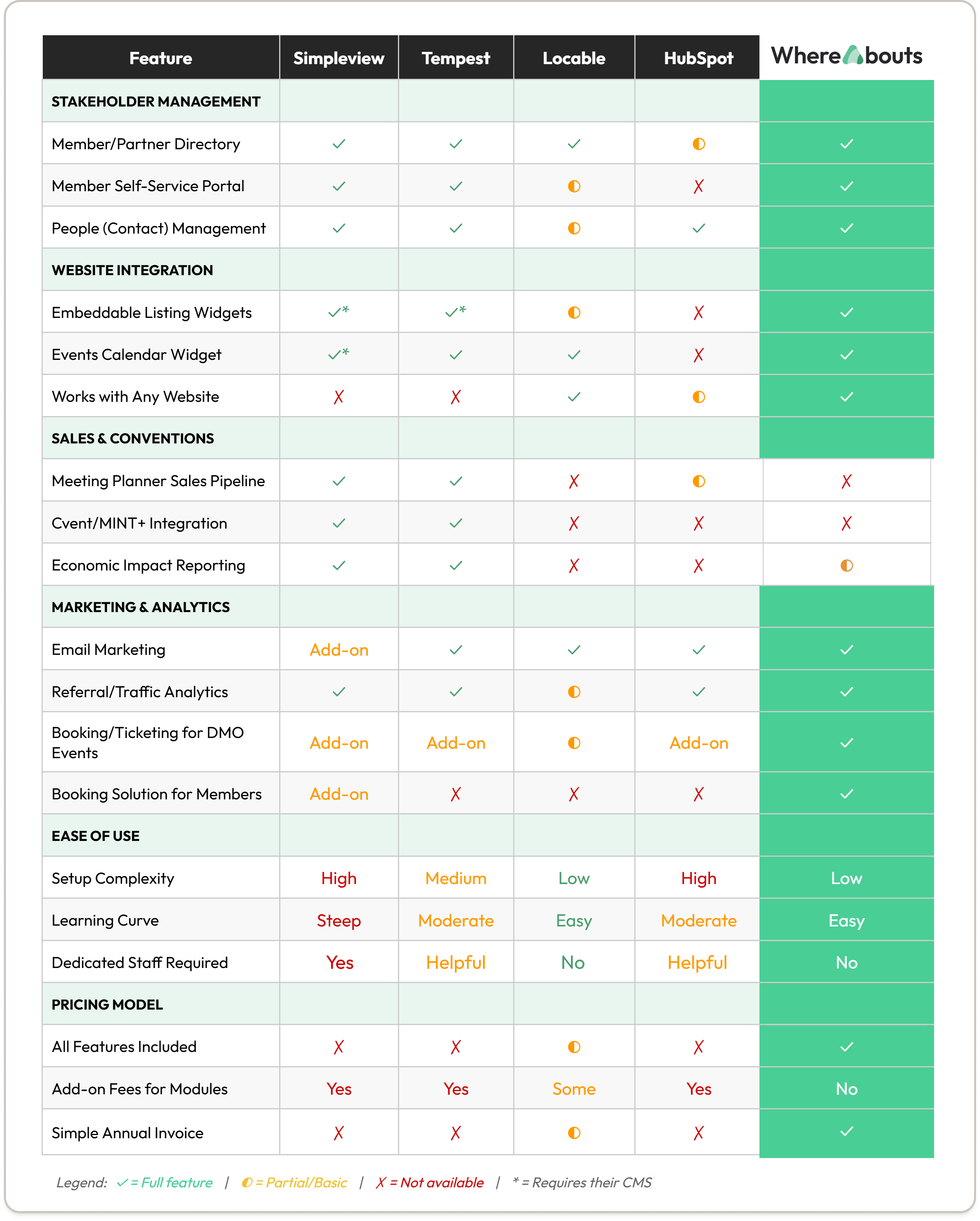
Feature comparison matrix
Which DMO CRM is right for you?
Choose Simpleview if:
- You have a dedicated convention sales team chasing meeting planners
- Economic impact reporting to stakeholders is critical
- Budget exceeds $50,000/year for technology
- You need deep Cvent and MINT+ integrations
- You want to be part of the industry's largest DMO community
Choose Tempest/iDSS if:
- You want a Simpleview alternative with strong support
- Sports tourism is a key part of your strategy
- You value monthly platform updates and modern technology
- Your team attends industry conferences for training
Choose Whereabouts if:
- You're a small to mid-sized DMO without convention sales needs
- Website widgets and stakeholder management are priorities
- You want members to update their own listings
- You want one predictable annual invoice with everything included
- You want to prove value to stakeholders with easy analytics
- You want to help local businesses sell bookings directly through your DMO website
- You need to ticket your own DMO events (AGMs, training, FAM tours)
- You're tired of being nickel-and-dimed for every feature
Choose Locable if:
- You're a small community organization (Chamber, Main Street, small DMO)
- Community calendar and local business promotion is your focus
- Budget is under $5,000/year
- You need something simple that "just works"
Choose HubSpot if:
- Marketing automation is your top priority
- You have existing HubSpot experience
- You're willing to hire a consultant to configure it
- Tourism-specific features aren't essential
The bottom line
There's no "best" DMO CRM. Only the right fit for your organization's size, needs, and budget. Enterprise platforms like Simpleview and Tempest make sense for large CVBs with convention sales teams and six-figure technology budgets. But for the hundreds of smaller destinations that don't need (or can't afford) those tools, purpose-built alternatives like Whereabouts and Locable offer a better path.
The worst choice? Trying to make a generic CRM like Salesforce or a spreadsheet system work for tourism. You'll spend more time fighting the tool than managing your destination.
Whatever you choose, the key is selecting a tool that lets your team spend time on impact, marketing your destination, rather than wrestling with data entry and complicated interfaces.


